Search This Blog

Showing posts with label ship. Show all posts

07 August 2012

Forward

In high school, I was in Nansen house. When I found out that the ship built for Fridtjof Nansen, the Fram, was in a museum, I was keen to see it.

Turned out to be a pretty amazing museum.

Fram
Much like the Vasa museum in Stockholm, the Fram museum is built around the ship, with three levels of catwalks providing different perspectives on the ship.

At the moment they also have a special exhibit on the tragic Terra Nova Antarctic expedition. As this was on the ground floor, it was my first stop.

Note Shackleton's crazy-eyes and monobrow
The exhibit went step by step through the Scott expedition. Some of it I knew already (the rivalry with Shackleton, losing to the Norwegians, Oates' last words) but there were some personal items on display, along with some interesting facts I'd not heard.

Roald Amundsen (whom the museum held up as the greatest explorer of all time, but they are a touch biased) left two letters at the pole. The first was written to the King of Norway confirming his reaching the South Pole, the second to Scott asking him to deliver the first. I guess you don't become the greatest explorer of all time without being a touch audacious.

None of these photos came out very well
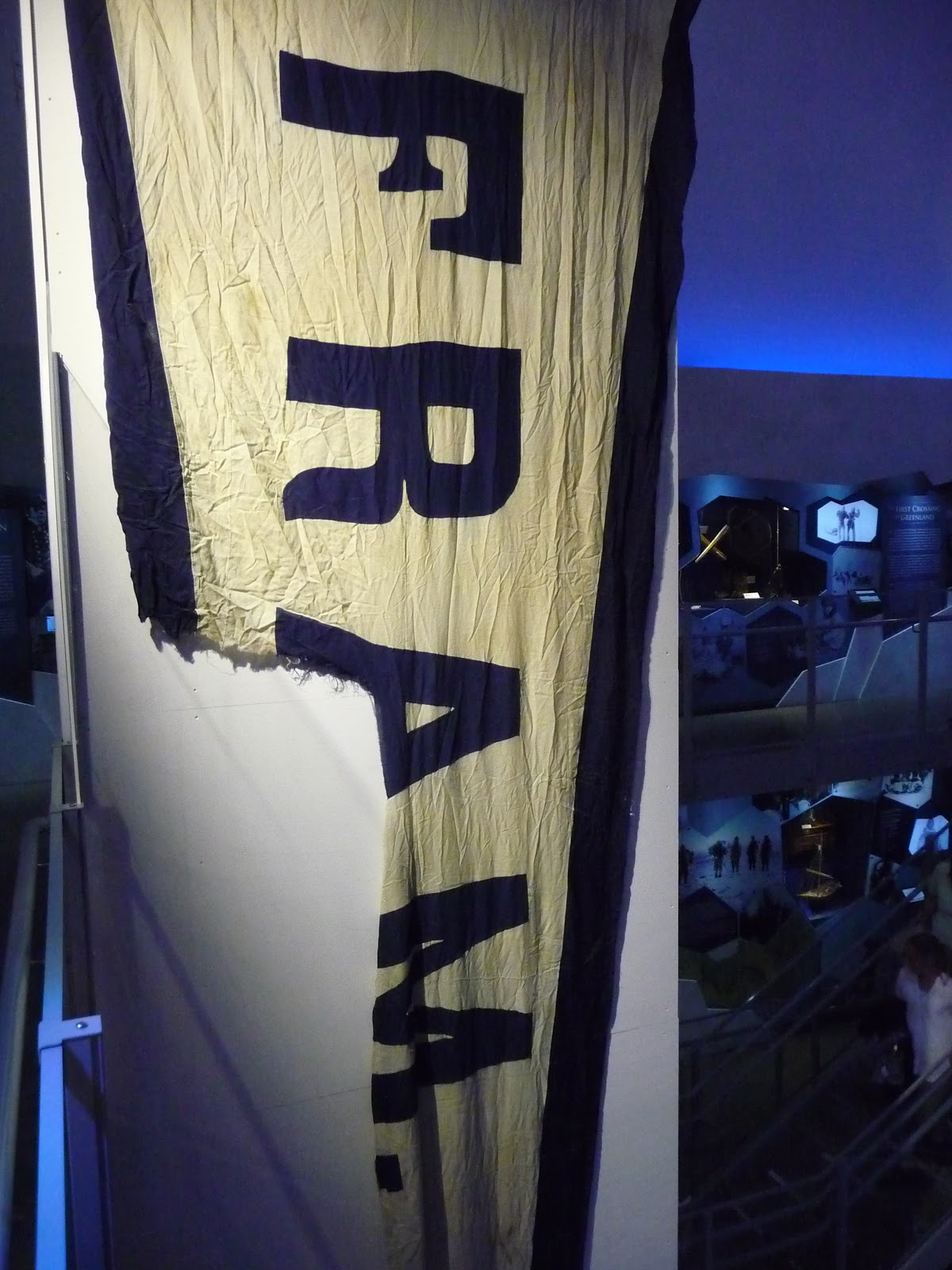
The crucial difference between the Vasa museum and the Fram museum can be found at the top level where, to my great joy, I discovered I could walk aboard the Fram. And inside it. A number of the decks and cabins were open and items from the various expeditions were on display. Unfortunately they proved difficult to photograph due to the lighting used in the museum.

Good diorama or great diorama?
The Fram is a big fat tub. She is tall and not very long which, when you consider she was built to spend years in the Arctic ice, makes sense. She was designed so that under the pressure of the ice she would rise up rather than crack.

The Fram museum also had a number of exhibits on the explorers who had used the Fram. First amongst them was Fridtjof Nansen.

Penetrating stare
I did not know, before I went, how dedicated to science he was. In fact, he wanted more scientists on the first Fram expedition, but couldn't find any who were willing to put up with the conditions (years living on the ice shelf). He himself was a biologist and oceanographer who ensured that scientific discovery remained as important to the Norwegian Arctic and Antarctic programs as the race to the Poles.

I want one.
  
Say cheese!
Outside the museum stands a set of statues commemorating the first men to arrive at the South Pole. They're all facing south. It was a beautiful day in Oslo, hot and humid with clear skies. They looked out of place in their polar gear.

05 August 2012

Oh ship!

Okay. This one has been a little while coming.

I went to Oslo to see the viking ships. There are three in the astutely named Viking Ship Museum (not to be confused with the museum of the same name and subject matter in Roskilde). The museum is a fjord away from the city center, where I was staying. There's a bus which goes (very) regularly but the best way to get across is by ferry.

It offers great views of the fortress.
It was good museum weather the morning I went over, and a lot of people seemed to have the same idea as me - even at 9am the ferry was full. The area it goes to has the Ship museum, the Cultural History Museum, the Maritime Museum, the Kon Tiki museum and the Fram museum all within a couple of kilometers.

Forward!
I got to the Fram museum later in the day, but I'm covering that in a separate post.

So. The ships. I fought through the eight (8!) bus loads of Spanish and Russian tourists (my first boganskiis!) and got my first look at the most famous item in the collection, the Osberg ship.

Click for the full size photo, have a look at the carving.
The Osberg ship is important for a bunch of reasons. It was the burial ship for a woman of importance (women were respected, respected women were buried like men). It is the most complete ship found to date, and there was a lot of stuff on board. All the gold and silver had been removed by grave robbers and, if there were any weapons originally buried, these were taken too. What was left was still fascinating; animals, a functioning cart, a few sleds, tools for food preparation and textile manufacture, all things to make life easier in the next world.

View from the stern; note the small rudder
The shape of the ship is also interesting. It sits low, only three or four boards above the water line. This, combined with the intricate carvings at the bow and stern leads people who know stuff about boats to think it was a pleasure craft, used for 'royal' days on the water. That this person was rich enough to have a leisure craft is fascinating as well. What interested me is that there is clearly a deck, with removable planks. I've since read that these could be lifted to bail the ship.

Next was the Gokstad Ship. Of the three, this was my pick.

Note the oar holes, the difference in the depth of the keel
Like the Osberg, this was a burial ship and like the Osberg, all the pretty stuff had been nicked by grave robbers. None of that matters though, because the boat itself is fascinating.

The rudder is huge, especially compared to the Osberg; even the tiller is much larger. But most interesting; it's removable. It could be lifted to allow this ship, which has a much deeper draft than the pleasure-boat above, to move through shallow waters without damaging the steering.

Also cool were the oar holes, which could be covered with wooden flaps to stop water coming in when the oars were shipped. The Gokstad ship is easily the largest clinker I've seen (it would have had 32 Oarsmen) and was reinforced with ribs. Much larger than this and the ship can't be clinker built.

What remains of the Tune Ship
The Tune Ship is the worst preserved of the three. It's also built of clinkered oak and would have been smaller than the others (around 24 oars).

Burial tent
Along with the Tune Ship were a number of larger items taken from the other burials; a tent, where the human remains and personal belongings were found in the Gokstad burial, and the Gokstad boats.

Smaller clinker boats from the Gokstad
The burial items reinforced both the intricacy and beauty of Viking era woodwork and the extended trading network that the Scandinavians possessed.

Wagon from the Osberg
I found it interesting that while the wagon would have been used only for special occasions, the sleighs would have been in common use. Dogs to pull the sleighs and horses for the wagon were also found in the Osberg grave.

Sleigh bar from the Osberg
And while robbers took all the silver and gold pieces from the burials, they did not take every item of bronze or iron, leaving behind some fascinating jewelry.

Smaller pieces, from all over the world
A lot of these decorate other simple items; the sheath of a knife or a belt or the like.

More shiny stuff
Upstairs they had the human remains from the graves on display. For all the talk of giant viking warriors, I need to remember that these people lived a thousand years ago. Tall meant something different then. One of them, a king in his prime, had legs which were not even as long as my arm. They might have been tall for their time, but we would tower over them today.

Keep that in mind when looking at the photos of the ships. What looks impressive to us would have been enormous to these tiny vikings.

And before I knew it, it was lunch time. I stepped out into the sunlight (it had become a beautiful day - see the photos from that afternoon, below) and went in search of a sandwich, a cup of coffee and the Fram.

Forward!

31 July 2012

I'm Bergen

Every few hours I would wake as the engines roared to life to pull us out from a pier. The ferry kept operating all through the night. Combined with the white night (the sun sets at night in the north, but it never really gets dark) it made for a strange sleep. I found it reassuring after a while; I never woke up wondering where I was.

I rose at what I thought was breakfast time but turned out to be not-quite-breakfast time and went to take some photos. I had to be careful not to stray too far. With an average passenger age around 86 I suspected there would be a rush for breakfast as soon as it opened.

Everyone wanted a photo of this little house
It was too windy to stay outside all day, and long stretches of bare coast provided few photo opportunities, but I felt bad sitting inside and reading (though I am reading Justin Cronin's The Passage and it is fantastic). In the end I tried to find a seat close to a window and the bow where I could check for upcoming photo opportunities.

There were many
As we approached Bergen the scenery changed. The hills and mountains became greener, the houses which had been built on strips between the slopes and the sea were built further up.

Still lots of cool islands
Entering the city from the water gives an appreciation for its layout I never got again, once I was wandering around it. Bergen is spread all about the fjord, anywhere there is land to build on.

But still very green, in summer
It was late when we got in. I had to wait for the next day to get a good view of the city from above.

30 July 2012

All down the broken coast

The ferry left at 10am and so, using the no information they provide on their website, I walked out of my hotel and in the direction of the huge ships. Given that the ships are enormous and Trondheim is not that big, it's probably fair that they provide no indication of where you should board the ferry. Once I reached the pier it became clear pretty quickly.

Once aboard I disinfected my hands (they had a thing about that), stowed my stuff in my cabin and went outside to get some photos.

A Trondheim raven hanging out on the ship's bow. I thought it augured well.
For all their talk of 'partial to no view,' the cabin was pretty good; spacious and comfortable. I was as far aft as could be and there was a bit of engine noise, but I didn't plan to spend a lot of time inside.

The advantage to booking late and being stuck with the expensive cabins.
The ferry itself is a working boat and takes cargo and people along the coast of Norway, in and out of the numerous fjords. Trondheim was a long stop-over, and a number of passengers took the opportunity to get off and look around.

For me the ferry finally offered an excellent shot of the Lade peninsular. For those of you playing along at home, one of the major characters in the novel I've written is the Jarl of Lade.

This is Lade
My objective was to get some really great fjord photos on the trip. Turns out fjords are freaking huge, and while they are beautiful to travel through they are impossible to effectively photograph from or close to the water level.

So most shareable photos come from towns, like this one in Molde
Any time the ship stopped we were invited to step off and have a look around.

Thanks for the photo, random German nona!
Those parts of the country were all glacially formed. The mountain ranges are ongoing, continuing even into the sea. They pop up as islands all along the coast, or sit just below the water's surface. The ferries have to stay to very specific routes, or risk tearing open on the underwater ranges.

The landscape was breathtaking; towns and farms built onto thin strips of land between ocean and mountains. An American passenger quipped, "they must be very concerned about global warming."

The price of natural gas is what they're worried about.
"And erosion," I said.

"I think all this is pretty stable," he said, nodding to the mountains.  "But when it goes, it goes big."

23 July 2012

If you had one day in Stockholm

"You have to see the Vasa," I was told before I left Australia. "You can't miss it, if you're in Stockholm."
Nils, one of the Austrians at the hostel, put it more eloquently. "The ship is... fucking... huge."

He wasn't wrong.

My mum said she wanted some photos with me in them. Thanks for making her happy, random Swedish dad.
Nils also warned us to get to the museum early. "By ten o'clock the tour buses arrive and you have to wait in line for, like, an hour," he said. I walked in at 0840 and took a few minutes to process what I was seeing.  The ship is enormous. Sixty nine meters long and about thirty tall (the tops of the masts were removed when she sank) it fills the huge space and commands constant attention.

But it's not just the size of the ship that captures you. German and Dutch sculptors were paid to create the beautiful carvings which decorate the ship.

The gunports had lions inside each cover. No two recovered were alike.
Using thousands of samples from all over the ship, researchers have an idea of the colours used. The result would have been... gaudy. But impressive. There's a mish-mash of mythology; Roman Emperors, Bible figures, traditional Norse legend, all with their own message for onlookers.

Tasteful and subdued.
And all of it displaying lions, the symbol of power and ferocity. The massive ship in the center of the museum is impressive enough; with flags flying and painted sculptures she would have been a marvel.

Some of the ingredients of the paints
The story of the Vasa is pretty astonishing. She sank twenty minutes into her maiden voyage when a strong breeze blew her over far enough that water came in through her lower gun-ports. With four of her sails still raised she sank by the island of Beckholmen.
(Quick aside - the hostel I'm staying in has named all its rooms after islands in the lake. I'm staying in the Beckholmen room)

The actual Vasa literally never looked like this model, because this one has all the sails raised.
The reigning theory is that the Vasa was too narrow. She was trying to be too many things. The king at the time wanted a ship with two gun decks and a fast ship, meaning she was too heavy and narrow, with not enough space for ballast to prevent tipping. But as our tour guide said; lucky for us. The waters of the Baltic preserve wooden ships better than any others in the world, so now Stockholm has an amazing museum.

The queue when I left. Went all the way down the street.
You might think it strange that I've written a post about how amazing this ship/museum is and included very few photos of the ship itself. The difficulty comes from the sheer size of the thing. It was very difficult to find a shot which would show her adequately.

Shot taken from the gallery at the aft, best I could do.
I dunno, maybe see it for yourself?