Search This Blog

Showing posts with label palace. Show all posts

18 August 2012

History served up like cake

Hm. Istanbul. Where to start.

As we left the airport it was different from other places I had been in Europe. The press of cars, sound of horns, the power of the sun. We rounded a corner on the highway and came in view of the old Byzantine sea wall and I had my Toto moment (we're not in Kansas, not the rains in Africa).

Two days of travel had left me pretty wiped. I explored the streets around the hotel (small, unevenly paved, confusing) but it was too hot to venture too far in a new city.

The organised tour I was on started the next day with a walk through the prominent sites in Istanbul's Old City. Our first stop was the Hippodrome.

*Insert your own overcompensating joke*
Ahmet, our guide, explained that this was where they used to race chariots in Byzantine Constantinople.

"Rad," I thought, "I can put the hippodrome in my novel."

Then he told us about the unfortunate outcome of the Nika riots.

"Great," I thought. "I can use the ruined hippodrome in my novel."

Where the hippodrome once stood is now Sultan Ahmet square, and it's still home to three Byzantine columns; the oldest of them, the Egyptian column, looks like it could have been put up last year. All three are dug into the ground, their bases around two meters below street level, because the city was much lower fifteen hundred years ago. Most of what Istanbul is built on is Constantinople, layer upon layer.

Also in the square is the Kaiser Wilhelm Fountain.

Looks German
The fountain was a gift from the Kaiser to the Ottoman Emperor. We were in the city for Ramadan, the one month of the year that the water in the fountain is operational.

Next stop: the Sultan Ahmet Mosque, better known as the Blue Mosque.

Doesn't look blue. Is this a language thing?
Named for the tiles which adorn the walls and ceiling, the Blue Mosque does have a funny language story behind it. Sultan Ahmet, who wanted it built, specified to the architect that he wanted a mosque with gold minarets. But the word for 'gold' and 'six' are very similar and the architect started work soon afterwards on a mosque with six minarets.

Oh yeah. That's pretty blue.
Lucky for him, the Sultan was quite taken with the idea.

We crossed back over to Topkapi Palace, the seat of power for the Ottoman Emperors for over 400 years.

Looks like a palace. But does it smell like a palace?
All of the things I wanted to photograph in the palace, like the armoury and the treasury, did not allow photography. But there were some great views outside.

Also, it rained.
Just outside Topkapi some ruins were being excavated; the remains of the Great Palace of Constantinople, the Byzantine palace.

Now the site of a luxury hotel.
We had some lunch and made our way to the Hagia Sophia, just as the sky blackened again. We just made it inside as raindrops the size of golf balls started pelting the city.

Ahmet took a moment to tell us a bit about the history of the church; about how it was rebuilt twice and has been standing in its current form since 537. About the columns inside, taken from the Temple of Artemis. How it was a church, then a mosque, and now a museum.

How it represents the development of Turkey.

It is... impressive
The conversion from cathedral to mosque has left some of the most amazing and beautiful sights. Because the Ottomans plastered over the original mosaics, they were largely preserved and can be seen today, though in many places the plaster remains, making both parts of the building's history are visible.

Each one had six wings...
This was another one of the "I am so glad I went on this trip," moments. How could I have sent Ragnar to Constantinople for almost eight years and not mention the Haiga Sophia once? Not even once? After seeing the stave churches where Christianity was practiced in Norway, this would have blown his tiny viking mind. And I haven't even mentioned it once.

Our last stop wasn't on the 'official' tour route, but Ahmet thought it was important for us to see; the Basilica Cistern.

Coooooooool
Another Byzantine structure, the cisterns all around the city provided Constantinople's water. Without a nearby mountain range to supply fresh water, the Romans built aqueducts (some still standing) to bring water and fill the cisterns (I haven't been able to find out where from - anyone know this?).

Where once it held 100,000 tons of water, it now has a fish pond.

All that took about eight hours and I was exhausted. We had an early start the next morning, heading for Gallipoli.

08 August 2012

22 July 2012

I thought you'd be taller

"I was expecting everyone to be seven foot tall and blond," I said. "I still feel pretty tall."
"No, we're just like anybody else." Our host, Axl, was blond but wasn't a giant. He was teaching us how to make kroppkakor and telling us about life in Stockholm.

Potato dumplings with bacon and onion drizzled with melted butter and a lindenberry sauce. Doesn't count unless you cook it yourself.

Earlier that day he had sent me to his favourite cafe in Stockholm, a few blocks from the hostel. I asked the mustachioed barista if he knew what a flat white was.
"Of course," he said. "We were not born yesterday." One of their staff was from Sydney, he told me, and flat white training had become mandatory. When he brought it to my table he boasted, "That one is so flat."
Better than passable, it was really good coffee.
With a coffee and a sandwich to fight jetlag, I explored central Stockholm, following the mall until I reached a huge building with guards. It took a few minutes to find the signs; I had found the royal palace.
Just guarding the crap out of it
In a way Stockholm reminded me of Sydney; a city designed with the landscape in mind. It's built across a number of islands in the mouth of  Lake Mälaren and I walked along the water's edge, crossing any bridge I came to.
There are many boats in Stockholm. Here's one.
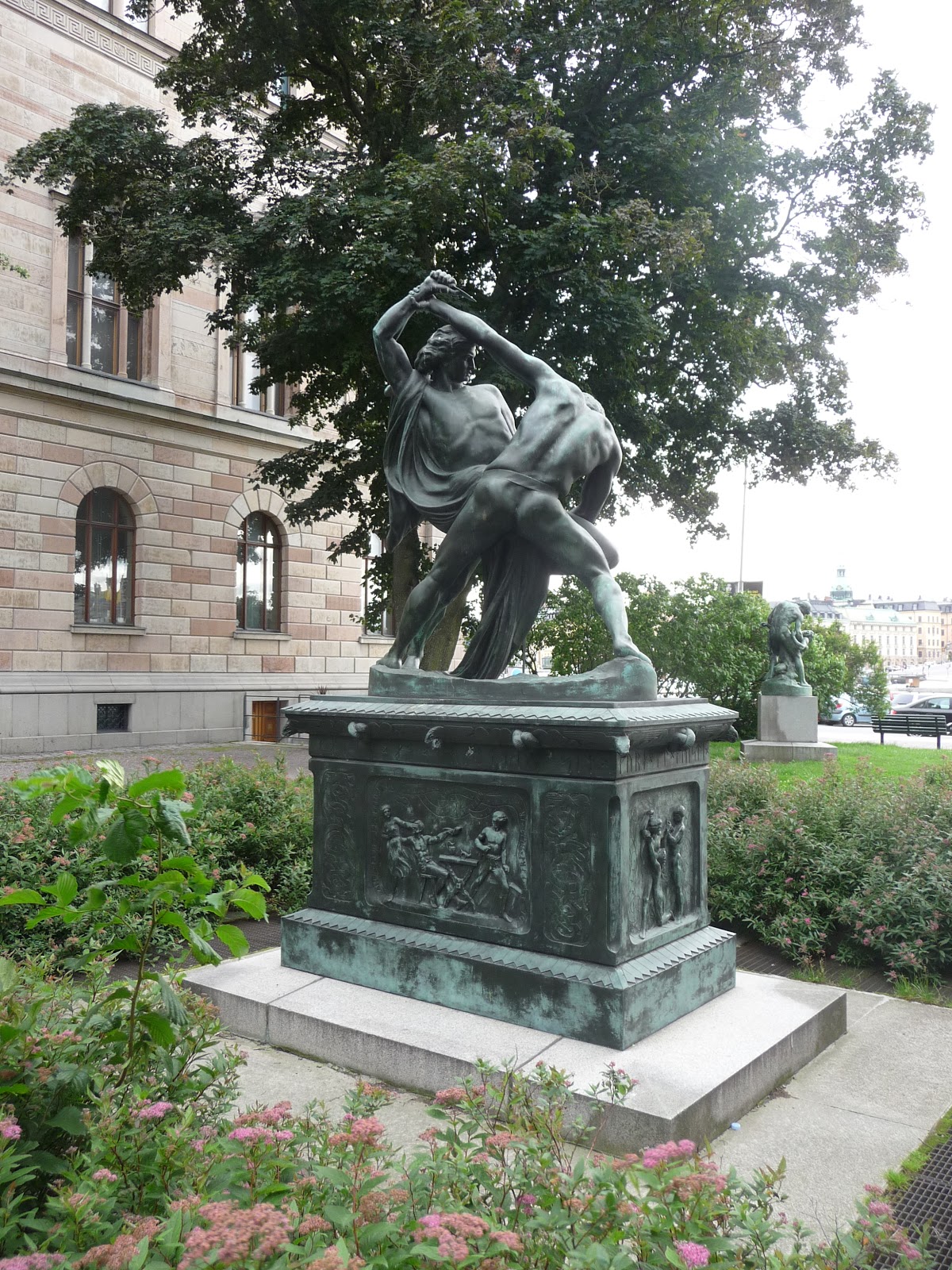
Not wanting to be late for dinner, I strolled back through the streets towards the city center. As I went I passed these guys.
It took me a couple of goes to see that their story was told around the statue.


The kroppkakor were good, the linden berries were fresh and tart and set off the potato well. I let the others tell me about what they had seen and done so far in Stockholm to get a sense of what I should do the next day. One thing kept coming up.

You've got to see the Vasa.

16 September 2010

One day in Vienna

Heldenplatz is dominated by two enormous equestrian statues.  The first we saw was of Archduke Charles of Austria.  


Heldenplatz itself was a mess.  We had arrived in time for some kind of food and agricultural festival.  As such, the only photo I could get of the palace features portaloos.


The other equestrian statue is of Prince Eugene.  He was a military-savvy Frenchman, which is not a sentence I get to write often.


As we approached the entrance of the Palace the Liar said; "oh, look, they've put out their flag collection."


I've posted already about the arms and armour museum in the palace, but the building itself is worth visiting.  Everything is finished in marble, the halls and staircases seem to go on forever.


The building itself was an ambitious project, and never actually finished.  I found this hard to believe when I heard it, because it's enormous.


From his horse, Prince Eugene had a good view of the festival, and of Vienna right to the Rathaus.


When we got out of the palace, this happened:


Just around the corner is an impressive statue of Francis II, who was the last Holy Roman Emperor.  He dissolved the Empire after defeat at the hands of Napoleon.  He was also Francis I of Austria, having founded the Austrian Empire.


The afternoon was spent wandering the backstreets of Vienna, eating wurst and drinking coffee.  It was also a very pleasant afternoon, as the old town of Vienna is gorgeous.


We went back to Mafiosi for dinner and had gnocchi. An American couple at the table next to ours struck up a conversation, so we met Stan and Gail who have invited us to visit them in Iowa when we undertake the Great American Road Trip.


That rounds out our 'big day in Vienna' posts.

Armour and swords and guns, oh my!

On a double recommendation, we hit the Hofburg palace to check the collection of arms and armour therein.  Three hours and 400 photos later, we emerged convince we had seen one of the greatest collections of 16th and 17th century armour in the world.


Most of this armour isn't "Medieval," but from the early renaissance.  Guns had long since rendered plate armour useless on the battlefield, but jousting and other such sports remained very popular.  These harnesses were essentially expensive sporting equipment.


Some of them would have been almost unwearable, and were designed only to be collectors pieces.  As such, the designs frequently mirror the fashions of the time.


I really enjoyed looking at the exchange sets with different visors.  The visors which gave a human expression were amusing.  The ones designed to look like animals were better.


As we moved through the museum, the influence of different fashions and 'designers' became quite apparent in the different styles of armour on display.


There were hundreds of guns on display, and while the many wheel-locks and flint-locks on display were beautiful, it was this revolver which really took my fancy.  If nothing else, it looked more functional than the ivory rifles in the cases.


Some weapons were distinctly designed not to function.  There was a period when designers were looking to be creative, rather than good.  This 'all in one' weapon was designed to hold all of the tools used in fencing, as well as an oil-lantern in the shield.  The oil lantern could be flared during night-fighting to blind an opponent.  Unfortunately it was very difficult to keep alight, and carried the risk of spilling burning oil all over the user.


The tournament and field harnesses were quite different from the parade and formal suits.  They were distinctly functional, brutal in design and function.


At the end of our time in the museum, I found this picture as a 'special display,' showing the Teutonic knights winning a victory over the Ottomans.  In fact, the curator told me, the Teutons were wiped out to a man.  Score one for history.


More photos of Wien coming.