Before I left Australia I showed my boss, whose husband is Turkish, where I was going in Turkey.
"Pamukkale," she said. "Huh."
"What's up? Not good?"
"No, no," she thought about it for a moment. "I'd be interested to see what you think of it."
"Why?"
"Well, it's nice. But when we were there it was just full of... Russian bogans."
"Oh," I said. "Boganskis?"*
"Sure. Boganskis."
Hierapolis (modern day
Pamukkale) was famous way back when for the pools of Aphrodite, the hot springs which were supposed to have healing qualities and provide the gifts of youth. In those ancient times, gullible people, called by the promise of such bollocks, flocked there to swim in the legendary pools.
In that regard, not much has changed.
 |
| I was in it for the ruins |
The choice to drive out on a blazing summer day and swim in hot pools left this Australian tourist a little baffled, but there's no accounting for the actions of boganskis, who had arrived in the hundreds (thousands?). They marched up and down the white cliffs in tiny bathing suits and kilograms of gold jewelry, waiting for the healing waters to kick in.
 |
| The cliffs were stunning |
Unrestricted tourist access in the 80s and 90s has blackened the top of the cliffs, and people are no longer permitted to walk out much further than the top level of the cliffs. But in the blazing sunlight the white faces shone with a dazzling brilliance.
The effect was ruined somewhat by the hundreds of people who had come for no other reason than to sit in the man-made pools and sunbathe.
Lucky for me there was more excellent Greek and Byzantine architecture to see, including the Necropolis on the far side of the site.
 |
| And a round tower! Well, some of a round tower. |
Hierapolis was huge; the city sprawled across the top of the hills about the cliffs. A minibus offered a quick drive from one end of the site to the other, and it was a welcome relief from walking in the heat.
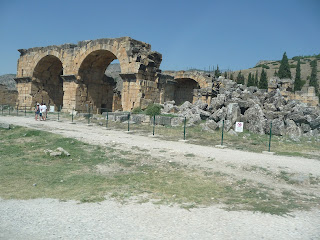 |
| We were driving at the time so I don't know what this is. |
The Necropolis itself was well worth seeing. I had no idea that Roman graves were so elaborate, and they were particularly interesting after seeing the burial rites of the Scandinavians, whose only lasting burial ornamentations seem to be cairns and barrows. I saw more runestones for sons and families who died in other countries than I did markers for the local dead.
 |
| The Necropolis goes all up and along the hillside |
I was, to be honest, a little under the weather that day, and I appreciated the opportunity to down a powerade and head to our hotel early for our tour's last night on the road. The whole next day would be spent heading back to Istanbul.
(not Constantinople)
*I've written this account like I came up with the portmanteau 'Boganskis,' when in fact this honour belongs to my mother.


