Our first day in Frankfurt was spent in the hostel. The Liar had contracted some kind of death-cough in Munich, and the traditional Bavarian remedy of 5-10L of beer hadn't cured him. For my part, I had determined that I would not face another German city until I had stopped shaking.
I didn't like Frankfurt at first; it reminded me of Sydney, or the way I think of Sydney, soulless and fake; a temple to money, a world city built for the sake of having a world city.
On the second day, I went out on a walking tour of the city. I'm glad I did.

There was a performing and installation art festival on while we were in town. The first stop on our tour was to view a piece a Swedish artist was putting together. Dressed in a uniform resembling a 1970's stewardess, she would ask people in the street if she could have the clothes they were wearing. She would then take down details about them as a small story, and stitch these to the clothes. The clothes were all sewn together into the web you can see here.

Towering over the old part of the city is the Dom. There are over 300 stairs going up to the top. I was told I couldn't go up, because I am too tall and too wide. I chose to take it as a complement.

Outside the Dom is the architectural garden. After World War II, the remains of a Roman bathhouse were found and exposed.

Inside we were pointed to this freeze. This is the original, put in during the Renaissance. It used to stand outside, where a replica now adorns the original plinth.

There's a common misconception that nothing in Frankfurt (and many other German towns) could be built taller than the Dom or Cathedral. This is not strictly true; the Dom's tower was build on exact directional lines, drawn into the floor. These were then carried the whole way up the tower, so it can be used to measure the points of the compass. Any architect working in the city could then use the Dom to calculate the direction their building was facing. If they built taller than the tower, they lost this advantage.

The floor of the Dom was lowered during restoration, and it was discovered that the gout lines no longer met their comfortable heights. So they were painted over, and fake ones painted on with more pleasing spacing.

The Dom's organ is quite famous (snigger).

The fresco behind the choir stalls is original, dating from the 13th century. In the 17th, it was decided the Dom should be more baroque, and the whole thing was painted white. When the building was bombed in World War II, these layers of paint protected the original fresco, which was then uncovered. There are currently plans to restore it further.

This squat man is Frankenstein. Though he has nothing to do with the book, he did live in the castle thought to be the eponym for Shelly's novel. He was pursued by the French and took refuge in Frankfurt, and is buried in the Dom.

This van Dyck painting was originally commissioned by a Cardinal, who didn't like it. Van Dyck then gifted it to an abbey, who immediately sold it. Eventually it wound up in the Dom.

There are a number of family crests adorning the walls of the Dom.

This one was my favourite.

Out back, we can see the replica freeze on the original plinth.

On the other side is a small memorial to the first Jewish cemetery in Frankfurt. The city's medieval record is not great when it comes to Jewish relations.

Frankfurt sits on the Main river. It boasts a number of pedestrian bridges, most going from the city center to the museum district.

Inside a smaller church in Frankfurt we were shown this hanging... thing, I can't remember what they're called. The point is, that is built entirely of stone. Nobody today knows how it's done, and architects from all over the world come to see it.

Charlemagne! Supposedly, he is the name-sake of Frankfurt. He wanted to cross the Main to fight a guy. Eventually he found a ford, where the city is now built. The German word for ford is furt; French-ford becomes Frankfurt. There is another Frankfurt in Germany, so I'm not sure how true this story is.

Behind him is the last original half-timber house in Frankfurt's center. There are still some suburbs which boast a number of these south-German classics, but all the others in the city center were destroyed in the war.

On top of the Rathaus are two statues of cats. Supposedly the city once found itself broke, and asked the treasurer what had happened to all the money. With typical dry German wit he replied; "I guess the mice ate it."

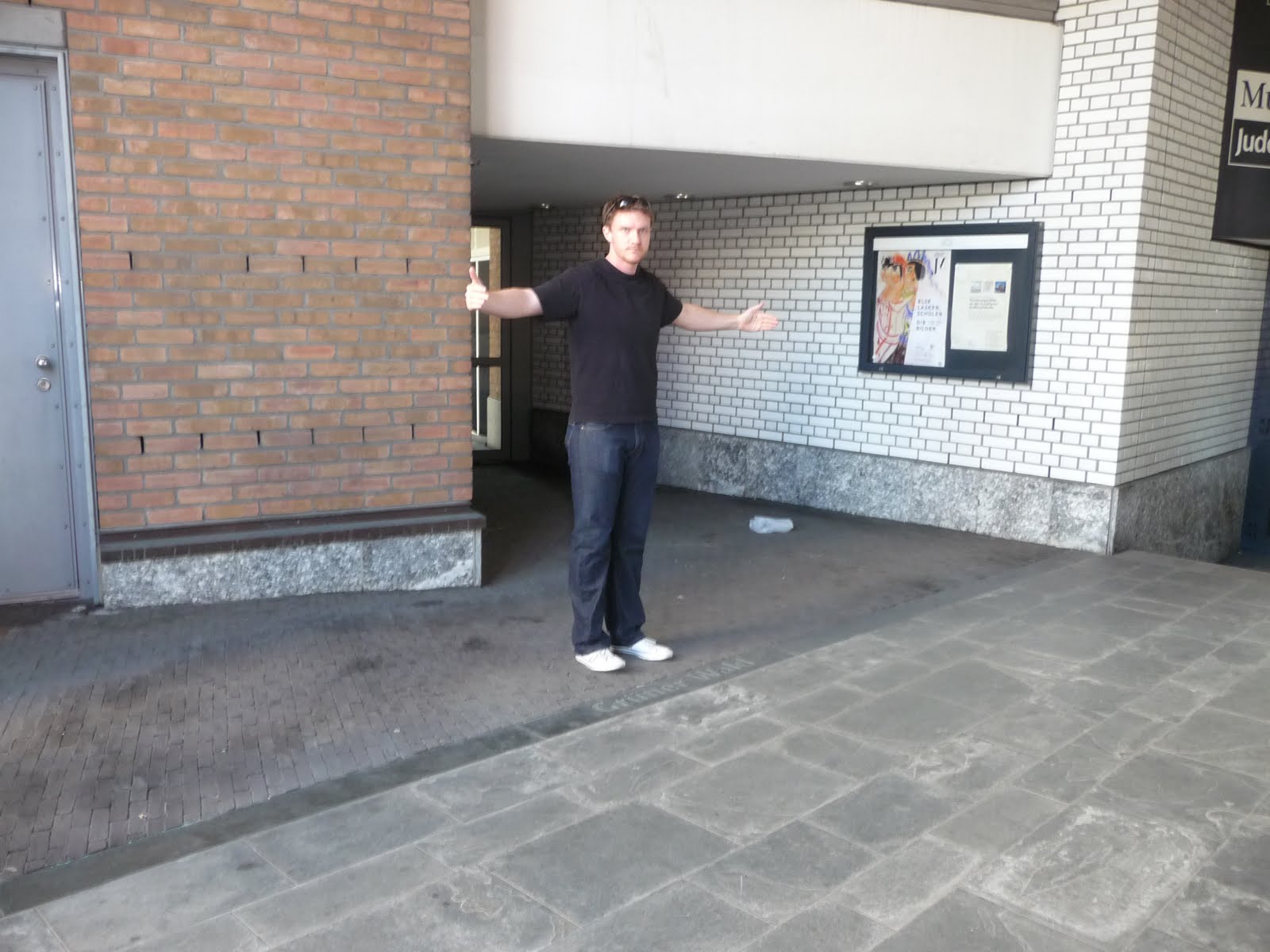
Next to the Jewish Museum in Frankfurt is another cemetery. Along the walls are individual memorials for anybody who was born, lived in or deported from Frankfurt to the Nazi concentration camps. There are 20,000 plaques on the wall. It was a humbling sight.

Outside the museum the path is marked with the old ghetto houses. I got the tour guide to take this photo of me demonstrating how wide the individual apartments were. Families of four to eight would live in one of these.

The city's old watch-house was turned into a cafe a long time ago. When the metro system was being put in, the watch-house was a prime spot for a terminal, as it sits at one end of Frankfurt's central mall. The building was demolished, but with typical German care it was demolished brick by brick and when the terminal was complete it was replaced, better than before. It's still a cafe. An over-priced one.

Frankfurt's shopping district is dominated by a building with a sucking chest-wound. This is a tunnel made of glass panels which goes from the building's ceiling and out the side. There's a photo of it from the inside further down.

As with many of the cities we visited in Germany, Frankfurt is a dichotomy of styles; there are noticeable differences between pre- and post-war architecture. This is best seen right in the heart of the city, where medieval watch towers and skyscrapers built in 2009 stand almost shoulder to shoulder.

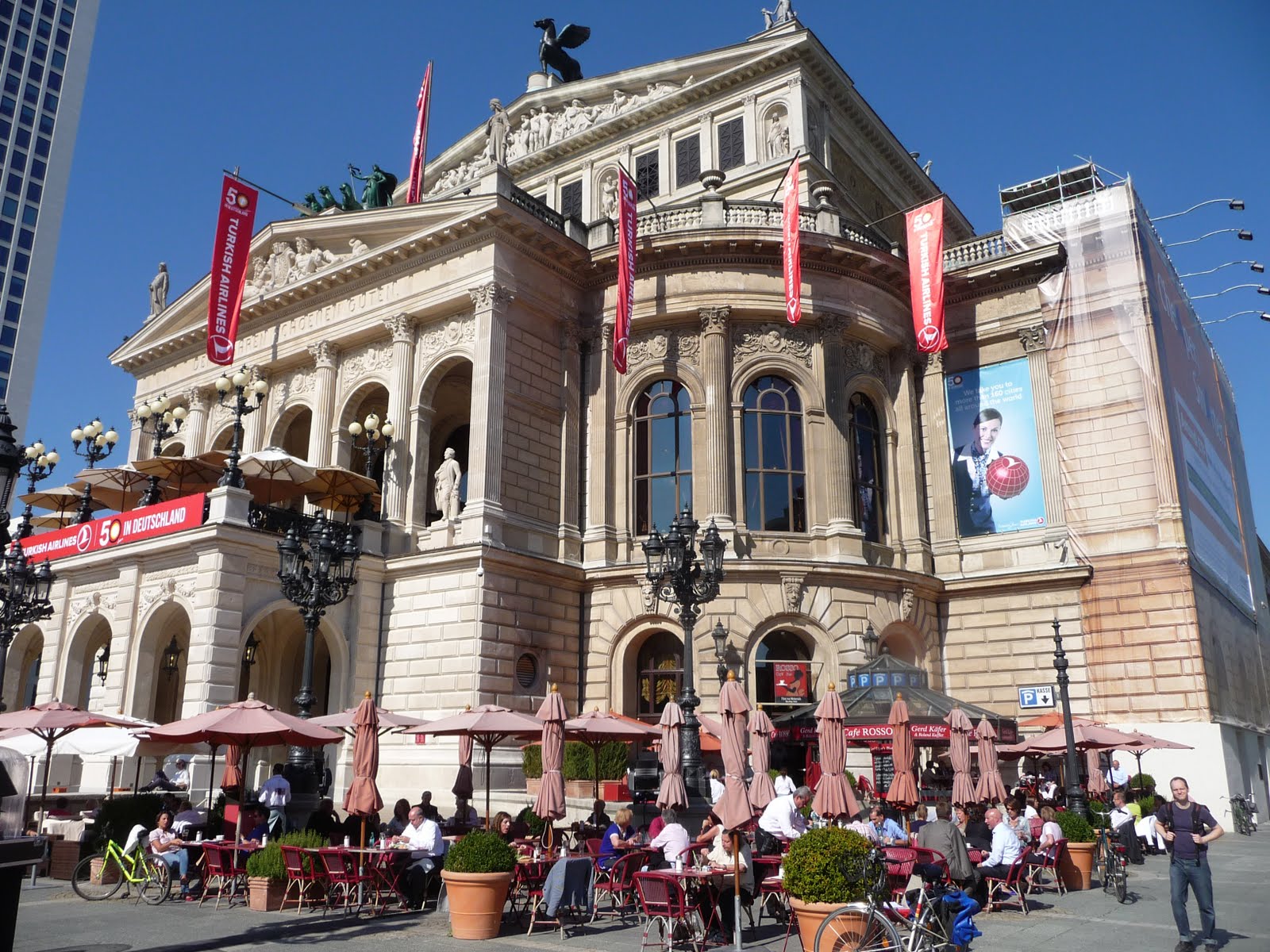
The old opera house was built using money donated by the people of Frankfurt. It's no longer an opera house, but it's still one of the most beautiful buildings in the city. The story goes that upon its completion the Kaiser came to see it, and stated that he could never have built anything so beautiful as the German people would question the expense.

Goethe is something of a hero in Frankfurt, hence the enormous statue dominating a massive empty square (Goetheplatz) in the middle of the city.

He was born in a house which has been restored to its original condition. This was one of the first buildings restored post-war, even though Germany wasn't exactly a tourism hot-spot at the time. The people of Frankfurt love him so much, they didn't even consider his house an attraction; it was a necessary part of the city. There's now a Goethe museum just next door.

This is the sucking chest-wound seen from the inside, looking up. I'm told it leaks like a sieve when it rains.

That was that. The next day was our last in Germany, dominated by packing and airports. Then we flew to New York.